![]()
×
单击图片或按ESC键关闭
document.head.appendChild(style);
HD-MC04 Aluminum-based PCB Technical Data sheet
Test base :
HD-MC04 Aluminum-based PCB
Thickness of copper:35um
Dielectric layer : 120um-130um
Cu base: 1.6mm
The result of the test:
|
No |
Test item |
U. |
Assay |
|
1 |
Peel Strength |
A |
N/mm |
1.5 |
|
After thermal stress(260℃) |
N/mm |
1.3 |
|
2 |
Blister test After Thermal stress |
/ |
(288℃,2min)
No Delamination,No blister |
|
3 |
Thermal resistance |
℃/W |
0.45 |
|
4 |
Thermal-conductive Factor |
W/m·k |
2.2 |
|
5 |
Flammability(A) |
/ |
FV-0 |
|
6 |
Surface Resistivity |
A |
MΩ
|
3.68×10⁷ |
|
Constant humidity treatment(25℃~65℃,
RH:90%~98%,20 circulate) |
3.39×10⁶ |
|
7 |
Volume Resistivity |
A |
MΩ
|
4.2×10⁸ |
|
Constant humidity treatment(25℃~65℃,
RH:90%~98%,20 circulate) |
3.17×10⁷ |
|
8 |
Dielectric Breakdown AC(leakage 5mA) |
KV |
6 |
|
9 |
Dielectric constant(1MHZ)(40℃,93%,96h) |
/ |
4.24 |
|
10 |
Dielectric dissipation factor
(1MHZ)(40℃,93%,96h) |
/ |
0.03 |
|
11 |
CTI |
V |
600 |
|
12 |
Operating Breakdown (AC) |
V |
500 |
|
13 |
Glass transition |
℃ |
125 |
|
14 |
Thickness |
um |
120 |
Method Description
1- Optical 2- Internal TO-220 test RD2018 3- Calculation from ASTM 5470
4-Extended ASTM 5470 5-ASTM D149 6-ASTM D150 7-Internal MDSC test RD2014
8-UL 746E 9-ASTM D2861 10- CPCA 4105-2010
Note: For applications with an expected voltage over 480 Volts AC,
HUADING recommends a dielectric thickness greater than 0.003”(76um)
Note: Maximum test voltage is a function of material and circuit
design.Typical proof test not represent the maximum.
Note: Circuit design is the most important consideration for determining
safety agency compliance.
HD-MC06 Aluminum-based PCB Technical Data sheet
Test base :
HD-MC06 Aluminum-based PCB
Thickness of the copper:35um
Dielectric layer:120um-130um
Thickness of the aluminum-base: 1.6mm
The result of the test:
|
No |
Test item |
U. |
Assay |
|
1 |
Peel strength |
A |
N/mm |
1.4 |
|
After thermal stress(260℃) |
N/mm |
1.2 |
|
2 |
Blister test After Thermal stress |
/ |
(300℃,2min)
No Delamination, No Blister |
|
3 |
Thermal resistance |
℃/W |
0.4 |
|
4 |
Thermal-conductive Factor |
W/m·k |
2.5 |
|
5 |
Flammability(A) |
/ |
FV-0 |
|
6 |
Surface Resistivity |
A |
MΩ
|
3.5×10⁷ |
|
Constant humidity treatment(25℃~65℃,
RH:90%~98%,20
circulate) |
3.38×10⁶ |
|
7 |
Volume Resistivity |
A |
MΩ
|
4.3×10⁸ |
|
Constant humidity treatment(25℃~65℃,
RH:90%~98%,20
circulate) |
3.2×10⁷ |
|
8 |
Dielectric Breakdown AC(leakage
5mA) |
KV |
6 |
|
9 |
Dielectric constant (1MHZ)(40℃,93%,96h) |
/ |
4.1 |
|
10 |
Dielectric dissipation factor(1MHZ)(40℃,93%,96h) |
/ |
0.031 |
|
11 |
CTI |
V |
600 |
|
12 |
Operating Breakdown (AC) |
V |
500 |
|
13 |
Glass transition |
℃ |
130 |
|
14 |
Thickness |
Um |
120 |
Method Description
1- Optical 2- Internal TO-220 test RD2018 3- Calculation from ASTM 5470
4-Extended ASTM 5470 5-ASTM D149 6-ASTM D150 7-Internal MDSC test RD2014
8-UL 746E 9-ASTM D2861 10- CPCA 4105-2010
Note: For applications with an expected voltage over 480 Volts
AC,HUADING recommends a dielectric thickness greater than 0.003”(76um)
Note: Maximum test voltage is a function of material and circuit
design.Typical proof test not represent the maximum.
Note: Circuit design is the most important consideration for determining
safety agency compliance.
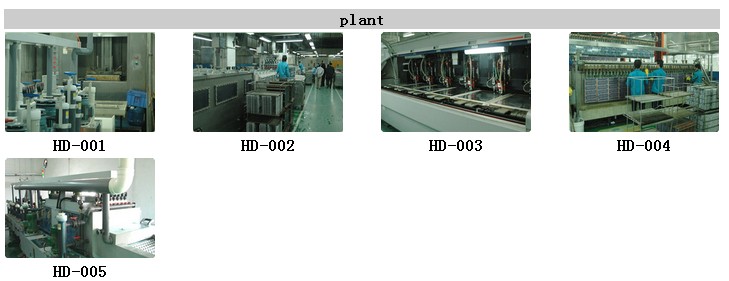
Plant